
After 50, social networks are reconfiguring due to concrete transitions: children leaving, career endings, separations, relocations. These disruptions remove the contexts where connections were formed by default, without a voluntary approach. Re-establishing a friendship circle at this stage of life relies on specific mechanisms that social science research helps to identify and mobilize.
Isolation and loneliness after 50: two distinct realities
The confusion between isolation and loneliness obscures the understanding of the problem. Isolation is measured by the rarity of contacts, while loneliness is a subjective feeling. One can be surrounded by others and feel profoundly alone, or have few contacts without suffering.
The Solitudes 2025 survey by CRÉDOC for the Fondation de France indicates that relational isolation is more common between the ages of 40 and 59 than in the adult population considered as a whole. Therefore, the difficulty in forming connections is not an issue reserved for the very elderly.
This distinction guides the response to adopt. If the problem is isolation (few contacts), the priority is to multiply opportunities for meeting. If it is loneliness (a felt void despite a surrounding), the work focuses on the quality and depth of exchanges. Seeking to make friends after 50 starts with an honest diagnosis of one’s own situation.
Regularity of meetings: the mechanism that transforms a stranger into a friend
Participating in an activity once does not create friendship. Regularity is the determining factor in forming a bond. Social psychology research shows that familiarity, built through repeated exposures in a shared setting, precedes trust, which in turn precedes intimacy.
A concrete example illustrates this principle: the association Lire et Sourire, which organizes volunteer visits, requires a commitment of at least one year. It indicates that the regularity of visits is the foundation of the trusting relationship with the people being accompanied. This observation applies to any attempt at friendship.
What regularity requires in practice
It is not enough to sign up. One must return, even when motivation wanes, even when initial exchanges remain superficial. A weekly class, a fixed workshop, a regular volunteering slot works because they replicate the conditions of the schoolyard or the office: a common place, a fixed schedule, a shared activity.
- A creative or sports workshop at a fixed day and time creates an implicit appointment with the same people, week after week.
- A long-term volunteering commitment (food aid, tutoring, home visits) exposes one to shared emotional situations, a powerful accelerator of closeness.
- A local walking or hiking group, with its own rhythm, allows time for conversation without the pressure of face-to-face interaction.
The common trap is to flit from one activity to another hoping for an immediate spark. Building an adult friendship requires several months of regular attendance.
Deepening a budding connection: the transition from group to personal relationship
The collective context is a springboard, not a destination. Many people in their fifties remain stuck at the stage of pleasant exchanges in a group without ever crossing the threshold to a personal relationship. Individual initiative makes the difference: suggesting a coffee after the activity, sending a message to check in, proposing an outing for two or three.
This approach requires a form of accepted vulnerability. Proposing something means accepting the possibility of rejection. At 50, the fear of rejection has not disappeared; it has simply changed form. It no longer manifests as adolescent shyness but as polite restraint, a “let’s keep in touch” that leads nowhere.
Three levers to move from collective to individual
The first lever is the concrete proposal. Not “we should meet one day,” but “next Tuesday, coffee at this place.” Precision reduces the decision-making effort for the other person.
The second is sharing a difficulty or doubt. Purely positive exchanges (“everything is fine, and you?”) remain superficial. Mentioning a concern, an uncertain project, or a personal question opens a space for reciprocity.
The third is the consistency of follow-up. After an initial in-depth exchange, follow up in the days that follow. Adult friendships often die more from neglect than from conflict.

Activities and settings conducive to lasting friendships after 50
Not all contexts are equal for creating deep connections. The most effective activities combine three characteristics: they involve shared learning, they repeat over time, and they place participants in a form of collaboration rather than competition.
- Learning workshops (foreign language, musical instrument, cooking, pottery) create shared vulnerability. We are all beginners together, which levels social postures.
- Volunteering with regular missions exposes one to strong human situations, conducive to authentic conversations.
- Discussion groups or book clubs allow for expressing opinions, debating, and thus revealing oneself beyond the surface.
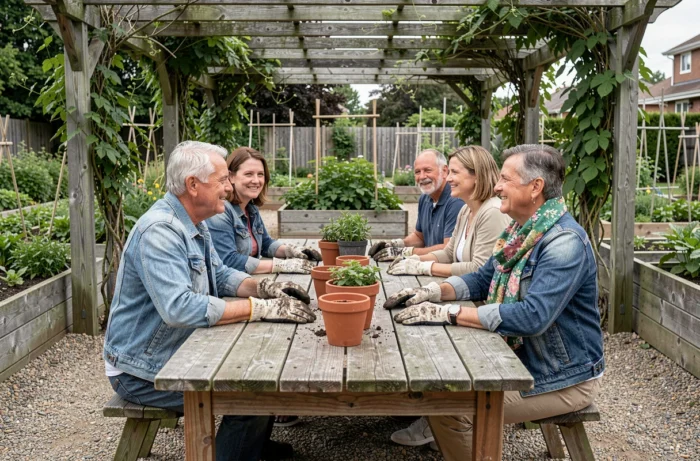
- Collective neighborhood projects (community gardens, neighborhood committees, local events) anchor relationships in a common territory and daily life.
Learning contexts are particularly effective because they replicate the school dynamic: a stable group, a common goal, shared moments of difficulty. The difference is that at 50, one chooses what to learn and with whom.
The issue of digital technology deserves a sober mention. Friendship dating apps and online groups can serve as a first filter to identify people with similar interests. However, the bond only solidifies through regular physical contact. Digital technology is a tool for connection, not a substitute for presence.
Building new friendships after 50 requires neither particular social talent nor a change in personality. The mechanism relies on three simple pillars: placing oneself in regular contexts, taking the initiative to transition to individual connections, and accepting that the process takes time. The only truly constraining condition is regularity, the kind that transforms a familiar face into a friend.