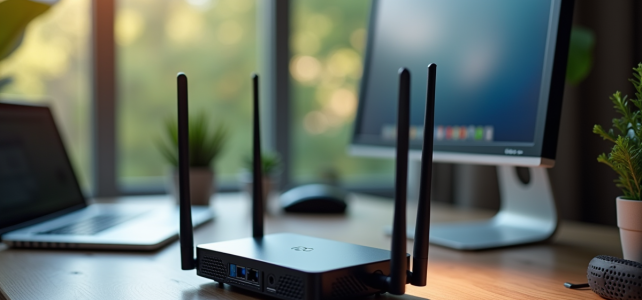
Communication between two computers on the same local network does not go through the Internet or an Internet service provider. Most devices connected in a home or business have been using the Ethernet protocol since the 1980s, but the majority of users are unaware of the difference between an IP address and a MAC address. Home networks often include wireless access points, switches, and routers, without a clear understanding of their specific roles. Despite the ubiquity of Wi-Fi, wired connections remain the benchmark for stability and security in data exchanges.
What is a local network for? Understanding its essential role in our digital daily lives
Plugged in everywhere and seen nowhere, the local network shapes the digital life of households as much as that of businesses. Without it, any exchange of information would quickly become tedious. This system connects workstations, computers, printers, or connected devices to make data flow fast, reliable, and direct, all on the same site. The wide area network (WAN) connects the entire world, but here, the LAN focuses on proximity, speed, and ease of use.
Setting up a local network enables file sharing, access to shared resources, centralized administration of the Internet connection, and even automatic data backups. At home, it synchronizes TVs, consoles, smartphones, and PCs, facilitating content distribution while securing exchanges. In the office, it structures the entire digital ecosystem of the organization, centralizes management, encourages collaboration, and protects internal flows. For some enthusiasts, it is a playground for experimentation. For example, redirecting traffic to 127.0.0.1 : 49342 is a familiar practice for those who love to explore the intricacies of the network.
Thoughtfully designed, the local network simplifies access to all resources, restores control over exchanges, and optimizes cost management. It constitutes this invisible yet solid axis of any serious IT infrastructure, prepared to withstand unforeseen events and ensure maximum availability. Whether at home or in a professional setting, designing a network thus involves considering topology, cybersecurity, and its interaction with other networks, public or private.

The components and operating principles of a local network explained simply
Once connected, the various elements of the local network each play their part. The switch directs data between different devices. Each device includes a network card that links the physical world, electrical signals, and the digital world of data. The way all these components are arranged, known as network topology (star, bus, ring), affects the speed and reliability of the flows.
Overall, several devices are used to ensure the coherence and efficiency of the local network. Here are the main tools employed for daily operation:
- Wi-Fi access points to wirelessly connect computers and mobile devices
- Routers that act as relays with the Internet and organize the distribution of IP addresses
- Cabling (copper or fiber optic) for fast and reliable transmission
Network segmentation is also used to isolate certain data flows, enhance security, or limit disruptions between services. Sensitive environments opt for VLANs, which logically separate groups of users, even if they share the same physical medium. Network security goes beyond just the Wi-Fi password: it requires enhanced authentication, filtering systems, and constant monitoring of access.
Behind the scenes, the OSI model organizes data transmission into several layers: physical support, logical transport, application… Each has a specific mission to ensure the integrity and routing of data packets. Protocols serve as a code of conduct, ensuring that information passes through each step without a hitch.
Here are the fundamental points for managing a local network smoothly:
- The use of network administration tools to centralize management
- Precise access control, user segmentation, and incident monitoring
- Compliance with standards and regular inspection of flows to identify potential vulnerabilities
Deploying a network infrastructure thus requires method and thought. Smartly equipping oneself, structuring everything coherently, monitoring aspects of IT network security, all of this builds a reliable foundation capable of supporting daily digital activity without faltering. In terms of local networks, every detail matters, and robustness always pays off.