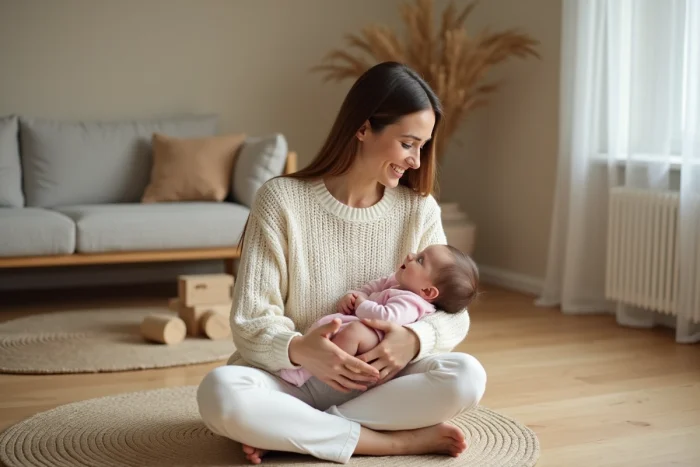
The well-being of a baby goes beyond just meeting their physiological needs. It relies on the quality of daily interactions, the consistency of rituals, and, less intuitively, on the psychological state of the adult caring for them. Understanding these mechanisms allows us to act on the right levers from the very first weeks of life.
Serve and return interaction: the engine of infant awakening
The socio-emotional and cognitive development of the baby is largely built through what developmental neuroscience calls the “serve and return” play. The principle is simple: the adult vocalizes or makes a face, waits for the baby’s response (look, cooing, movement), then imitates or continues the exchange.
This back-and-forth is not trivial. The Center on the Developing Child at Harvard University has included it as a key recommendation in its 2022-2024 guides, given its documented effect on building neural connections. The baby learns that they can act on their environment, which lays the foundation for trust and communication.
For these awakening games to work, a few guidelines help explore the Petits Bambins website for baby to choose sensory toys suitable for each age group, from rattles to the first texture books.
A common mistake is to multiply stimuli. A baby under three months does not need a musical mobile, a bright play mat, and a vibrating stuffed animal all at once. One stimulation at a time, in a calm environment, produces more learning than an overloaded environment that tires the still immature nervous system.
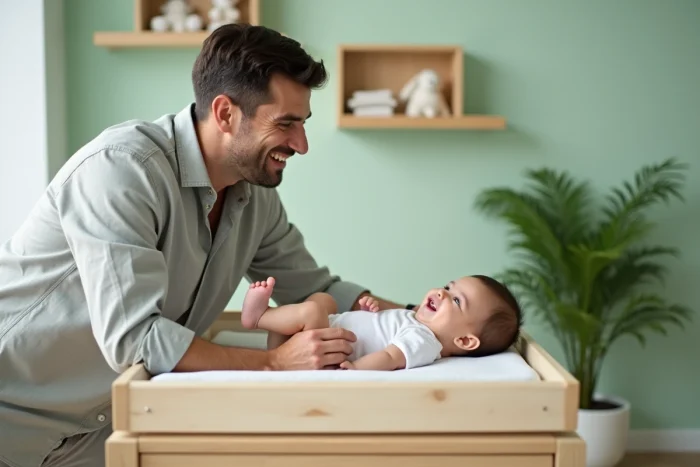
Baby sleep and soothing rituals: a direct link to parental health
Supporting an infant’s sleep is not just about the child. A literature review published in Sleep Medicine Reviews in 2023 by Dr. M. Mindell shows that regular sleep rituals and a sensitive response to crying are associated with a decrease in the risk of postpartum depression and anxiety in parents.
The recommended approach prioritizes maintaining a gradual day/night rhythm rather than “training” for sleep. The baby perceives the adult’s tension. An exhausted or anxious parent will find it harder to maintain a consistent ritual, and the infant will feel this through muscle tone, heart rate, and vocal intonation.
Components of an effective night ritual
- Gradually reduce the brightness and sound volume in the room at least twenty minutes before bedtime to signal to the baby that it’s time to sleep
- Repeat the same sequence every evening (warm bath, light massage, soft song or words) so that the child anticipates and calms down through predictability
- Respond to nighttime cries without excessive stimulation: low voice, slow gestures, dim light, to avoid restarting a complete wake cycle
This framework benefits both the child’s sleep and that of the parents. A parent who sleeps better regulates their emotions better, and this regulation directly impacts the quality of interactions the next day.
Parental well-being and baby development: the link that guides overlook
Most resources on infant awakening list sensory activities, age-appropriate games, and developmental milestones to monitor. They overlook a determining factor: a parent overwhelmed by stress cannot offer quality interactions, no matter how well-intentioned they are.
Surveys conducted in France and Europe after the COVID-19 pandemic highlighted the extent of parental isolation. The mental load associated with infant care (feeding, sleep, medical appointments, household organization) accumulates, and many parents’ first reflex is to sacrifice their own recovery.
Realistic strategies to protect parental balance
Caring for the parent is not a luxury or a selfish interlude. It is a direct lever on the child’s development. A few concrete adjustments can make a measurable difference.
- Delegate at least one daily task (bottle feeding, diaper change, walk) to another adult in the household or a close relative, even occasionally, to break the feeling of constant responsibility
- Identify a fixed time slot of twenty to thirty minutes per day without parental demands: reading, walking, silence, whatever the activity, as long as it is freely chosen
- Accept that the “good parent” is not the one who constantly stimulates their baby, but the one who remains emotionally available during moments of interaction
- Talk about difficulties with a healthcare professional (midwife, doctor, perinatal psychologist) as soon as fatigue becomes overwhelming, without waiting for the situation to worsen
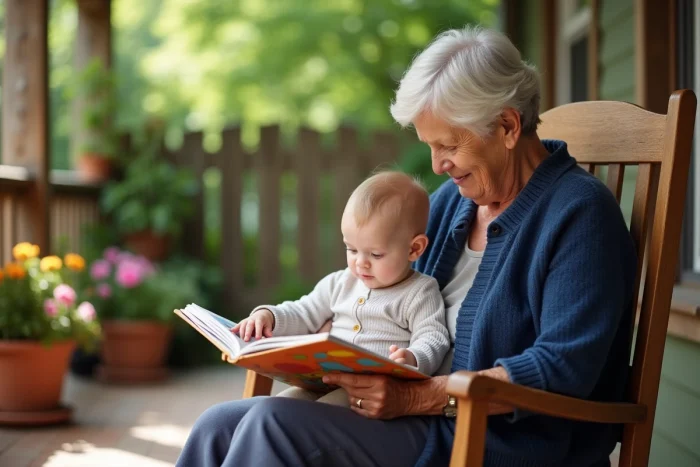
Age-appropriate sensory activities: less equipment, more presence
Infant sensory awakening does not require a massive investment in toys. In the first months, the human face remains the most captivating stimulus for an infant. Visual contrasts (black and white), varied textures (fabric, smooth wood, soft rubber), and gentle sounds are enough to nourish their curiosity.
As the child grows, activities become more complex, but the principle remains the same: the quality of adult presence matters more than the sophistication of the toy. A plastic cup filled with dry lentils, closed and shaken together, generates as much learning as a forty-euro electronic toy.
The family environment also plays a structuring role. An open play space on the floor, a bed visually accessible from the living area, objects within reach: these simple arrangements promote autonomous exploration while maintaining visual contact with the parent.
The baby’s development follows its own timeline. A child who does not grasp an object at four months or who does not babble as much as a same-age neighbor is not necessarily delayed. Each infant progresses at their own pace, and constant comparison unnecessarily fuels parental anxiety, which in turn degrades the quality of interactions.