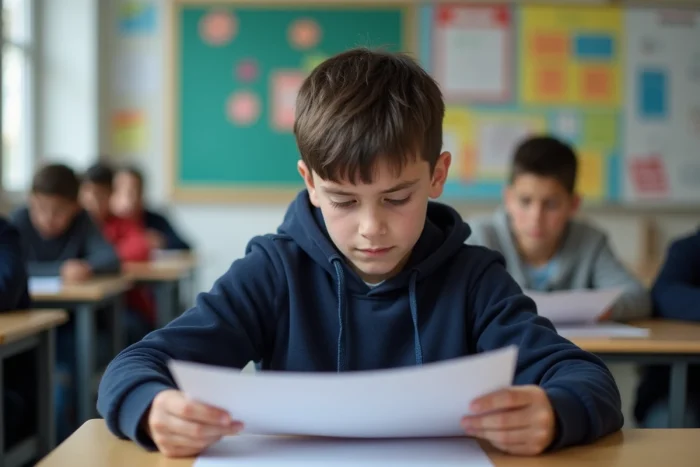
No official table sets the threshold to be crossed to access 4th grade: the minimum overall average remains, in practice, a matter of usage, often pegged to a symbolic 10 out of 20. In the absence of standardized national data published by the Ministry of National Education, understanding the reality of averages in 5th grade requires delving into various reports and surveys, which outline a very contrasting educational landscape depending on the academies and institutions.
The latest national assessments in French and mathematics for 5th grade leave little room for blind optimism: the overall level stagnates, sometimes slightly declines. This discreet but real decline weighs on orientation choices and on how teaching teams support students, sometimes as early as the middle of the cycle.
Overall average in 5th grade: definition, calculation, and official expectations
Before questioning the numbers, it is essential to understand what the overall average in 5th grade concretely encompasses. It synthesizes each student’s results by aggregating their grades, weighted by coefficients specific to each subject. These coefficients, determined by the national education or adapted locally, carry significant weight, especially for key subjects like French and mathematics. The report card reflects this construction, and each class council relies on it to inform its decisions.
The French grading system, with its scale out of 20, establishes the average as a thermometer closely monitored by families and teachers. Subjects with high coefficients, such as French and mathematics, naturally weigh more, but other subjects, from sciences to languages and arts, also map out this level achieved throughout the year.
The overall average in 5th grade in France goes beyond a mere administrative figure. It fits into a broader logic of progression, driven by the expectations of the Ministry of National Education. Even though no threshold is etched in law for moving up to 4th grade, reality shows that the 10 out of 20 mark often serves as a reference point. This flexibility allows room for each institution’s discretion, but trends identified in recent analyses reveal clear contrasts depending on territories and student profiles.
What numbers for 5th grade? Analysis of results and recent trends in France
The various publications from the ministry outline a nuanced picture of the overall average in 5th grade. On a national scale, the average score hovers around 11 to 12 out of 20, with sometimes marked differences from one academy to another. Major urban areas, particularly Paris, often report better scores than rural or suburban sectors.
Let’s take a closer look at the breakdown by subjects: the gap is evident. Mathematics and physics-chemistry crystallize the difficulties: the average score in mathematics for a 5th grader hovers around 10.5/20, while French stabilizes near 12/20. Other subjects, such as history-geography and sciences, fall within this same range, while visual arts and music education frequently exceed 13/20.
Behind these averages lie sometimes worrying dynamics. The slow but clear decline in the level of mathematics raises concerns among many education professionals. The success rates for the national diploma remain high, but 5th grade stands out as a pivotal stage for consolidating knowledge. Social or territorial inequalities amplify the gaps in level: hence the importance of not settling for a superficial reading of academic results.

Reading comprehension, grammar: what levers to progress and limit the decline in level?
To halt the decline in level in 5th grade, focusing on reading comprehension and grammar remains fundamental. Everyone has a role to play: parents monitor the first signs of disengagement through the report card or while assisting with homework. Teachers deploy new tools: increased short exercises, reading workshops, regular writing. This tailored approach fosters progress, even when the slope seems steep.
Among the proven methods, some deserve to be integrated into daily life. Regular reading, outside of class hours, serves as a springboard: it broadens vocabulary and strengthens comprehension. The success workshops implemented by the national education, especially during vacations, target weaknesses to reinforce the foundations.
Here are some concrete practices to prioritize for progress:
- Active rereading of instructions and texts
- Training in short writing (summaries, syntheses)
- Collective analysis of written productions, in class or at home
The alliance between academic support and personal work nurtures a dynamic of progress. Digital tools, online dictations, or interactive quizzes complement this system. But nothing replaces the attentive presence of those around nor the consistency in effort. Ultimately, success is not just a matter of grades: it is the sum of a journey, made of small steps and openings, that is written every day in French middle schools. Because beyond averages, it is the individual trajectory that ultimately shapes each person’s educational story.