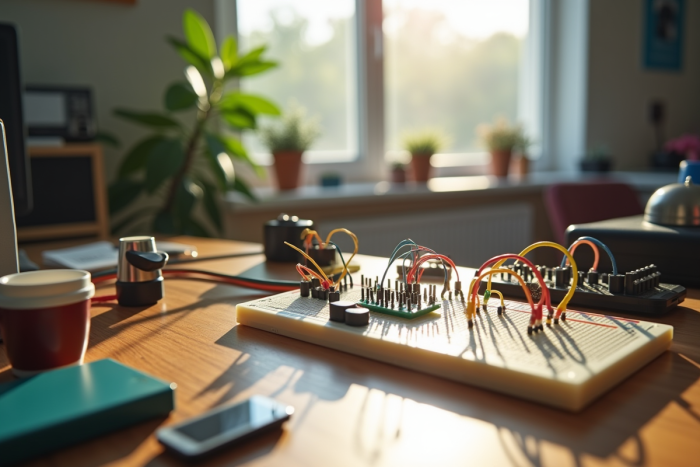
An electronic assembly tolerates neither improvisation nor unsuitable materials. A poorly chosen component or an unstable power supply skews any experimentation, even the simplest one. The absence of a few basic tools inevitably slows down learning and multiplies errors that are difficult to diagnose.
Beginners often overlook the importance of suitable kits or a reliable multimeter. However, a few well-selected elements are enough to limit risks and progress more smoothly. Mastery of the first manipulations depends as much on the choice of materials as on the quality of the resources consulted.
First steps in electronics: understanding the basics and overcoming apprehensions
Introduction to electronics offers a field of exploration where rigor and curiosity intertwine constantly. Electronics revolves around fundamental concepts: transfer and processing of information through the flow of electric charges. Each electrical circuit comes to life through a meticulous organization of electronic components connected to each other. Resistors, capacitors, LED diodes, transistors, operational amplifiers, and coils form the foundation on which initial experiments are based.
Here are some concrete examples to better visualize this foundation: the resistor limits current, while the capacitor stores energy. The LED diode lights up, signals success or an error, the NPN bipolar transistor is controlled by current, and the MOSFET by voltage. The operational amplifier is used to amplify a potential difference, while the coil opposes variations in current. Each of these components becomes a word in the technical vocabulary, an essential tool for learning through experimentation.
The Ohm’s law (U = R x I) connects voltage, current, and resistance, forming the backbone of electronics. We talk about voltage (Volt), intensity (Ampere), capacitance (Farad), inductance (Henry): each quantity has its own unit. Mastering these concepts involves manipulating and simulating circuits, for example via Falstad, which makes learning more concrete and gradually dispels the doubts of novices.
Before diving headfirst into purchasing equipment, consult the tool list from mon-club-elec.fr: it helps to outline your path, avoid the accumulation of unnecessary gadgets, and choose equipment that is truly relevant at the beginning. Progress also relies on using clear tutorials, simple projects, and repeating actions. Practicing, testing, failing, and then adjusting: this is how a solid and lasting understanding is forged. Learning in electronics is built through trials, errors, small victories, and the desire to go further.
Which equipment should you prioritize to learn and practice at home with confidence?
To start on solid foundations, it’s best to invest in a beginner’s electronics kit. This kit includes several essential elements:
- resistors
- capacitors
- LED diodes
- transistors
- buttons
- displays
- cables
- and sometimes even an Arduino-type microcontroller
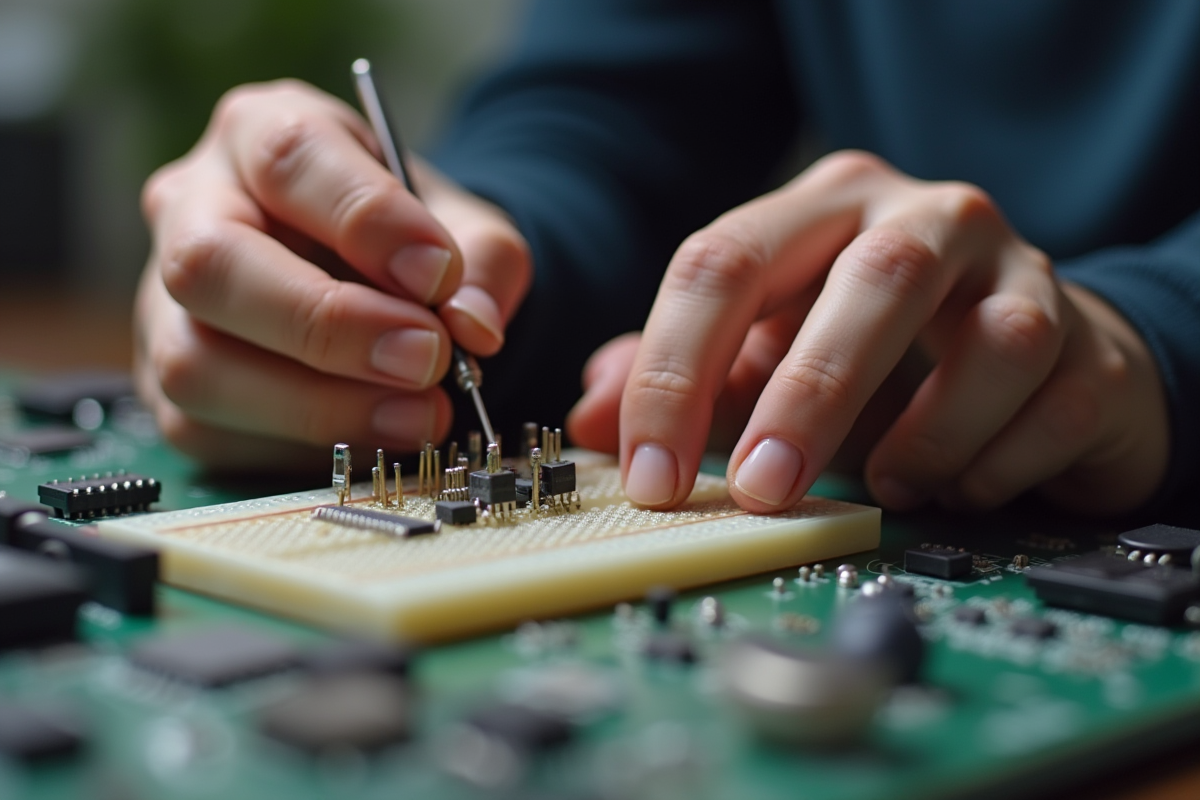
Another ally is the breadboard. It simplifies initial assemblies, as it avoids soldering, allows for mistakes, and facilitates quick adjustments. This flexibility encourages experimentation without the pressure of permanence.
The multimeter quickly becomes essential in the beginner’s workshop. It allows you to measure voltage, current, and resistance, check that an assembly works, or identify an anomaly. When it comes to assembling printed circuits, the soldering iron becomes useful. Choose a manageable model, accompanied by a stable stand and a sponge to maintain the tip. Don’t forget the solder, desoldering braid, or pump, which are useful for correcting or redoing imperfect connections.
A series of tools quickly proves indispensable for handling components with precision. Here’s what to plan for from the start:
- pliers, cutting and needle-nose
- a magnifying glass for inspecting circuits
- a cutter
- a wire stripper
To go further, some projects require an oscilloscope to visualize electrical signals or a laboratory power supply to provide a stable, adjustable voltage according to the circuit’s needs.
Online resources complement this setup: tutorials, specialized books, support forums, and dedicated websites allow for a deeper understanding of each concept. Combining practice with documentation accelerates learning, fuels curiosity, and builds confidence at every step. The more suitable the equipment, the easier it becomes to progress, grasp the logic of electronics, and develop new projects.
A well-thought-out workshop, tools chosen with discernment, and the desire to experiment: this is the winning trio to get started and enjoy electronics. Each person can invent their path, component by component, circuit by circuit. The rest is just a matter of imagination and perseverance.