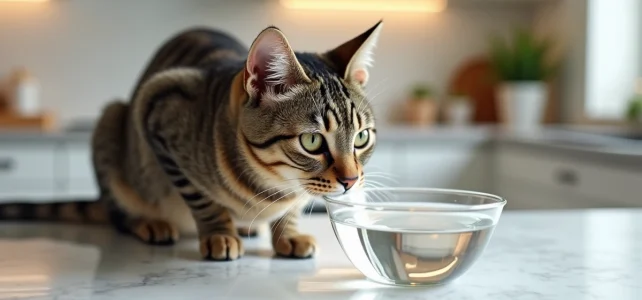
Your cat circles around its water bowl without touching it, or it settles for a few quick licks before moving on. This behavior, seemingly trivial, hides a hydration problem that affects its kidneys, bladder, and digestion. The type of water you offer plays a direct role in its daily consumption, and low-mineral bottled water represents a serious option for improving your cat’s health on a daily basis.
Water hardness and cat urinary health: what recent research says
Have you ever noticed white deposits at the bottom of your kettle? This limescale, composed of calcium and magnesium, is present in the water your cat drinks. For an animal whose urinary system is already fragile, this additional mineral load can be problematic.
A study published in the Journal of Feline Medicine and Surgery in 2024 (Grauer et al.) suggests that water hardness influences the frequency of idiopathic feline cystitis, regardless of stress or diet. The authors recommend considering low-mineral water for sensitive cats, without generalizing to all animals.
In practical terms, a cat fed with mineral-rich kibble already receives a significant intake of calcium and phosphorus from its food. If tap water is very hard in your area, the cumulative effect can exceed the recommended daily intakes. The revised AAFCO recommendations (2023) specify that the mineral intake from water should be included in the overall calculation of the cat’s ration, particularly for calcium, phosphorus, and sodium.
An article detailing the benefits of mineral water for cats helps to better understand how the choice of water affects urinary balance over the months.
Tap water, filtered water, or mineral water: what real impact on cat hydration
The cat is a finicky drinker. Its desert ancestor derived hydration from its prey, and this reflex persists: many domestic cats drink less than their bodies need. The taste and smell of water matter more than one might think.
The problem of chlorine in tap water
Tap water is treated with chlorine to eliminate bacteria. This smell, barely perceptible to us, can deter a cat to the point of reducing its consumption. Letting the water sit in a pitcher for a few hours allows some chlorine to evaporate, but does not address the mineral load issue.
Filtered water: a partial compromise
An activated carbon filter reduces the taste of chlorine and retains some residues. However, it does not significantly alter the mineral composition. For a cat prone to urinary stones, filtering alone is not enough to lower calcium or magnesium levels.
Low-mineral water
Low-mineral water limits the mineral accumulation with dry food. This is why several French veterinary clinics, including those of Dr. Valérie Freiche (Alfort) and Dr. Guillaume Ragetly, have reported since 2022 an improvement in water intake among cats with chronic kidney disease after switching from chlorinated tap water to low-mineral water.
These observations remain descriptive, but they have led some veterinary nephrologists to incorporate the type of water into their standard recommendations. The common point: cats drink more of water that has no chlorine smell and a neutral taste.
Choosing the right mineral water for your cat: practical criteria
Not all mineral waters are created equal. Some have sodium or magnesium levels that are too high for a small animal. Here are the guidelines to check on the label before filling the bowl:
- The dry residue should remain low. The lower this number, the less the water contains dissolved minerals. Waters labeled “low-mineral” have a dry residue significantly lower than that of regular spring waters.
- The sodium content should be as low as possible, as excess salt puts a strain on the kidneys and can worsen existing kidney failure.
- The combined calcium and magnesium content should remain moderate, especially if your cat eats kibble already rich in these minerals.
Read the label as you would read the composition of kibble: every milligram of mineral counts in the daily balance of a small animal.
Water fountain or bowl: adapting the presentation to encourage consumption
The type of water is not everything. The way you present it also affects how much your cat drinks.
A cat often prefers moving water. Water fountains create a slight current that attracts the animal and encourages it to drink more frequently. If you choose mineral water, pouring it into a fountain combines the benefits: neutral quality water and an attractive presentation for the animal.
Some simple adjustments can also improve water intake:
- Place the bowl or fountain away from the litter box and food. Cats do not like to drink next to where they eat or relieve themselves.
- Provide multiple water sources in the home. A cat that has to cross three rooms to drink will eventually skip it.
- Refresh the water at least once a day, even with a fountain. Stagnant water loses freshness and accumulates dust and fur.
- Prefer a ceramic or stainless steel container over plastic, which can alter the taste of the water.
A well-hydrated cat urinates more frequently, which helps to dilute crystals before they form stones. This is the most direct protective mechanism against lower urinary tract issues.
Diet plays a complementary role. A cat fed exclusively on kibble receives very little water from its food, unlike a cat that eats wet food. Combining a mixed diet (kibble and wet food) with low-mineral water offers the best chances of maintaining proper hydration in the long term.
The choice of water for your cat is not a cosmetic detail. It is a fully-fledged preventive lever, validated by recent clinical observations and consistent with AAFCO nutritional recommendations. Check the hardness of your tap water, compare it with your pet’s needs, and adjust accordingly. Its kidneys will thank you silently.