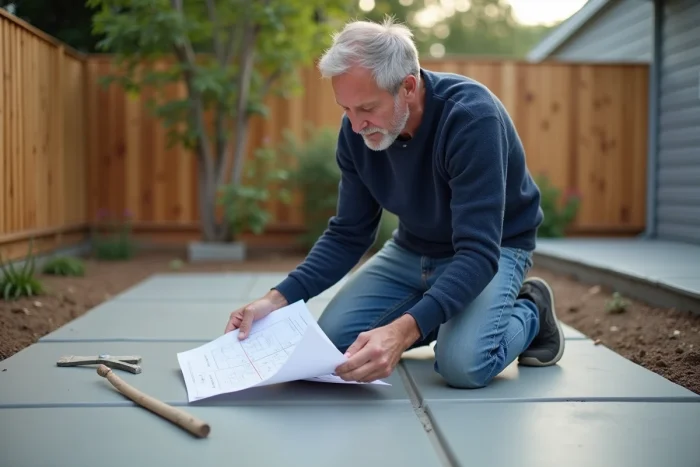
A concrete slab of 21 m² is not insignificant. Behind this simple figure, a fiscal and administrative reality awaits many property owners around the corner. Attached terrace, masonry platform, or independent slab: each scenario can lead to taxation, or even the requirement for a permit or declaration. Omitting this step opens the door to sanctions that far exceed a simple warning.
The distinctions between prior declaration and building permit are not mere legal subtleties. In the absence of uniform rules from one municipality to another, the risk of error looms even for the most cautious. The consequences are very real: tax audits, disputes with the town hall, or painful reassessment of property tax.
Concrete slab and taxation: what the regulations say for your terrace
The relationship between concrete slab and taxation leaves no room for approximation. Before embarking on the construction of a terrace, one must consider the obligation to declare it to the town hall. The local urban planning plan (PLU), when it exists, serves as an essential reference. Here are the main scenarios to keep in mind:
- For a ground-level terrace, without elevation or modification of the natural ground level, no formalities are generally required. However, caution is advised in protected areas or near historical monuments: the opinion of Monuments de France may then become essential.
- As soon as the ground area exceeds 20 m² or the slab involves an elevation, submitting a prior declaration of work to the town planning department of the town hall is mandatory. Some PLUs lower this threshold or add constraints, depending on location or proximity to property boundaries.
From a fiscal perspective, everything depends on the use and ground area of the slab. A concrete slab considered taxable area is included in the calculation base for development tax and property tax. Still in doubt? The answer to the question Do you need to declare a taxable concrete slab? deserves your full attention. Each project must be examined in light of the PLU and local regulations. Even a minor modification of the land or property boundaries can be enough to change the situation. Before starting work, it is better to seek the opinion of the town hall: caution avoids many complications.
What are the risks of undeclared work or errors in the declaration?
Ignoring procedures or making mistakes in the declaration of a concrete slab exposes one to very concrete consequences. The tax administration cross-references cadastral data, checks on-site, and analyzes every reported area. A discrepancy, even minor, can trigger everything.
- Fine: carrying out undeclared work on a terrace or concrete slab can result in a fine of up to 6,000 euros per irregular square meter, as provided for in Article L. 480-4 of the Urban Planning Code.
- Office taxation: forgetting to declare an area leads to retroactive regularization of local taxes, notably property tax and development tax. This regularization covers the last four years, with late interest to boot.
- Interruption of work: the town hall can order the immediate suspension of work, or even require the partial or total destruction of the slab, at the owner’s expense.
The deadline for declaring a concrete terrace runs up to 90 days after the completion of the work. Beyond that, regularization becomes much more costly, and good faith is no longer enough to avoid sanctions. An error in the form or the declared area can permanently impact the taxable base: property tax and development tax can soar, sometimes well beyond the initial cost of the work.
Before submitting the file, every detail counts: verification of data, anticipation of deadlines, requesting advice from the town planning department in case of doubt. Administrative services do not forgive forgetfulness or negligence.

Successfully declaring your work: key steps, documents to prepare, and distinctions based on types of terraces
The success of a prior declaration of work for a concrete slab relies on a precise method dictated by urban planning rules. First, it is essential to correctly identify the nature of the proposed terrace: slab at natural ground level, elevated structure, or covered. The ground area, height, and potential addition of a cover change the procedure to follow.
To declare correctly, the mandatory step remains the Cerfa form 13703*09. In addition, several supporting documents must be attached. Here is the list of documents to prepare:
- Site plan: it specifies the location of the land within the municipality.
- Mass plan: this document details the exact placement of the concrete slab.
- Graphical representation of the terrace, with top and side views.
- Photos of the existing situation, especially if the project involves renovation.
The type of terrace, whether ground-level, elevated, or covered, determines the authorization to request and how the development taxes will be calculated. In protected areas, the opinion of the architect of historical monuments becomes essential. Keeping track of progress with the town planning department, being rigorous about the declared area, and properly considering applicable VAT rates: this is what makes the difference between an accepted file and a delayed or sanctioned project.
At every stage, the concrete slab is therefore not just a simple masonry work: it requires constant dialogue with the administration, lest the taxation catch up with the construction. It is better to anticipate the rules rather than suffer them, as a poorly declared concrete slab leaves much more lasting marks than the concrete itself.