Despite its growing popularity, the expression “wallah lahdim” is often misunderstood, even among its regular users. Some religious authorities advise against its use, while it is becoming established in street conversations and on social media.
This phrase, oscillating between solemn promise and informal oath, transcends generations without ever losing its affirming power. Its polysemy and sometimes contradictory uses fuel debates and misunderstandings, revealing a cultural complexity rarely explored.
Wallah lahdim: an expression between oath and intensity
The term wallah lahdim has its roots in Arabic, crossing the borders of the Maghreb before becoming embedded in the daily lives of young French speakers. At its core, wallah means “by Allah”: a word given, an assertion one wants to be irrefutable. By adding lahdim, a popular transcription of the term al-‘adheem (“the Majestic”), the phrase intensifies. This oath then takes on a nearly solemn tone: “I swear by Allah the Majestic.” It is no longer just a simple promise, but a strong commitment, addressed both to the interlocutor and to God.
In everyday discussions, wallah lahdim serves as a cultural marker. It reflects the imprint of Arabic on spoken French, particularly among young people from working-class neighborhoods. Variants abound: wallahi, wallah al-adhim, or even the abbreviation “wlh.” All share this unbreakable link to the idea of a sacred oath.
The definition and meaning of wallah lahdim raises both religious and social questions. Some remind us that swearing on the name of God, for trivial matters or worse, to cover a lie, is severely condemned in Islam. Yet, the expression has become commonplace. It finds its way into discussions without always measuring its impact. Taking into account the context and each person’s sensitivity is to recognize that the word is not neutral. Its power extends beyond the religious aspect: it shapes the bonds between individuals, affirms belonging to a group, and perpetuates a constantly evolving linguistic heritage.
How has this phrase become established in everyday language?
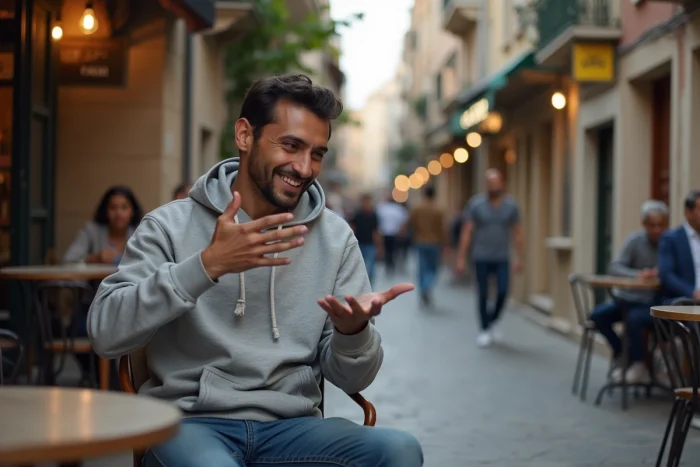
The emergence of wallah lahdim in spoken French is not trivial. In the suburbs, Arabic infuses daily life, transmitted by families from Maghreb immigration. The expression is exchanged at home, settles in the streets, and takes root in classrooms. Gradually, it spreads: in conversations among friends, on social media, in French rap. The French language enriches itself, transforms, absorbs this contribution from elsewhere.
Over time, wallah lahdim takes on a dimension that transcends its religious reference. The word becomes a code, a pledge of loyalty, a mark of trust among peers. Young people appropriate it, sometimes twisting its original meaning. In neighborhoods, it unites, distinguishing those who share a common culture. The expression then embodies this multiple identity, between family heritage and the affirmation of a distinct way of speaking.
This phenomenon does not stop with youth. Wallah lahdim slips into the mouths of adults, resonates on football fields, and finds its way into online discussions or the entertainment world. It can be heard in the midst of a video game session, during a heated debate, or to emphasize the sincerity of a statement. This diffusion reflects society’s ability to integrate and transform elements from elsewhere, turning them into pillars of popular language.
Nuances of use and perceptions in daily life
In French society, wallah lahdim circulates among conflicting uses. When pronounced lightly on a schoolyard, it distances itself from the gravity it carries in family traditions. Many Muslim parents remind their children: this oath is binding before Allah and, in tradition, it is only used in serious circumstances, before justice, to prove one’s honesty, or to guarantee a major promise. Its routine use in everyday life raises questions, sometimes causes discomfort, and sparks debates between generations.
The repetition of the word, particularly on social media or in rap, shows a form of trivialization of the religious. The expression slips from the sacred sphere to that of slang, becoming a simple identity marker or a speech tic. This evolution worries some believers, who remind us that swearing falsely is considered a major sin. Language specialists, like Adéla Šebková, observe this transformation: the expression, now embedded in the speech of young people, illustrates how French society is redefining its relationship with religion.
Here are some common or alternative forms encountered in everyday life:
- wlh, whl: abbreviations used in written or oral exchanges
- bismillah, insha’Allah, mashallah: other Arabic expressions used with different intentions
- Neutral phrases like “I assure you,” “honestly,” “believe me” to express sincerity without religious reference
Each use tells something about the context, identity, or relationship to language. Wallah lahdim continues to weave connections, but also to spark discussions and adjustments, revealing the vitality, and sometimes the tension, of a language that keeps evolving.
Tomorrow, in the mouth of a teenager or a father, the expression will change nuance again. Language never stops moving, and every word, every promise, carries its living trace.