
You are preparing connection work or a real estate sale, and you are asked for the sanitation network plan. The reflex might be to call the town hall, but this document can be found in several places, in various forms, and sometimes just a few clicks from your home.
Single window for networks: the option few individuals use
Before heading to the town hall, there is an online tool managed by INERIS on behalf of the Ministry of Ecological Transition. The online service “Construire sans détruire,” accessible at reseaux-et-canalisations.gouv.fr, allows you to locate public pipelines and collectors near a parcel.
The principle is simple. You fill out a project declaration (DT) or a simplified information request by providing the address of your land. Network operators respond with location plans, including those of the wastewater network. Even without an immediate construction project, this process provides access to the location of public collectors.
A point of caution: the plans received via this online service indicate the general layout of the networks, not the details of your private connection. To find out where to find the sewer plan with the exact positioning of your parcel’s connection, you need to cross-reference this information with other sources.
Geographic portals of intercommunalities: sanitation plans available for free
Several metropolitan areas and urban communities have opened GIS (geographic information system) portals where the wastewater network can be consulted for free. You enter your address, and the map displays collectors, manholes, and connection points.
The European Metropolis of Lille offers this service through its GéoMEL portal. The Metropolis of Lyon has an online accessible map of wet networks. Other local authorities are gradually following this digitization trend.
Check first if your intercommunality offers a geographic portal before taking any other steps. If so, you can obtain the plan in just a few minutes, without mail or appointments.
What to do if your municipality does not have an online portal
Not all local authorities have digitized their plans yet. In this case, two contacts can assist you:
- The sanitation service of your town hall or intercommunality keeps the plans of the collective network and can provide you with an excerpt upon request, often free of charge.
- The SPANC (public service for non-collective sanitation) intervenes if your land is in an individual sanitation zone. They have the zoning and can direct you to the right service if you are on the border of collective/non-collective zones.
- The urban planning service of the town hall holds the sanitation zoning plan, which distinguishes between areas connected to the sewer system and autonomous sectors. This document accompanies the local urban plan (PLU).
Prepare your cadastral reference (section and parcel number) before contacting these services. The response is quicker when the parcel is precisely identified.
Connection plan during a real estate sale: who provides it
During a transaction, the seller must attach a sanitation diagnosis to the file. For properties connected to the collective network, this diagnosis confirms the compliance of the connection. However, the diagnosis alone does not always contain the detailed layout of private pipelines.
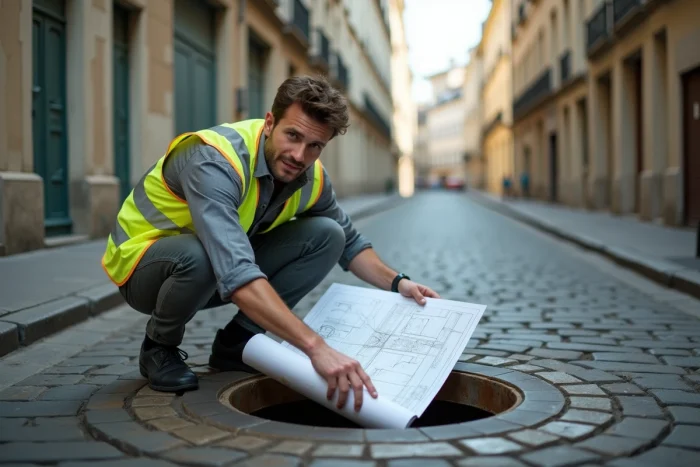
The urban planning and sanitation services increasingly provide a positioning plan of the connections upon simple request from the notary or the buyer. This document goes beyond the collective/non-collective zoning: it shows the exact location of the connection between the property and the public collector.
Are you buying a property and the seller does not have this plan? Direct your request to the sanitation service of the municipality. Most local authorities process these requests within a few weeks.
Compliance check and connection: two different documents
Do not confuse the certificate of compliance for the connection and the network plan. The certificate certifies that your installation complies with current standards. The plan, on the other hand, physically locates the pipelines.
For a new connection, the municipality or the network delegate conducts a compliance check after the work. The connection plan is then integrated into the technical file. If you have acquired an old property, this plan may never have been formalized. In this case, a camera inspection of the pipelines can help reconstruct the layout.
Collective sanitation zoning: check before searching for the plan
Before any plan search, ask yourself a preliminary question: is your parcel in a collective or non-collective sanitation zone? The answer determines the type of document to obtain and the contact person to reach.
The sanitation zoning can be consulted at the urban planning service of your town hall. Some municipalities publish it as an annex to the PLU, accessible online on the urban planning geoportal. If your parcel is in a collective zone, the sewer network exists or is planned. In a non-collective zone, there is no sewer plan to search for: it is the SPANC that manages the monitoring of your autonomous installation (septic tank, micro-station).
This zoning evolves. A parcel classified as non-collective sanitation can switch to a collective zone during a network extension. When purchasing, check the current zoning and not the one that appeared in an old notarial deed.
The sewer network plan is not a unique document stored in a drawer. It is distributed among the national online service, local GIS portals, the sanitation service of the municipality, and the sales file. Start with the geographic portal of your intercommunality: it is the most direct route. If this portal does not exist, the sanitation service of the town hall remains the reference point, with your cadastral reference in hand.